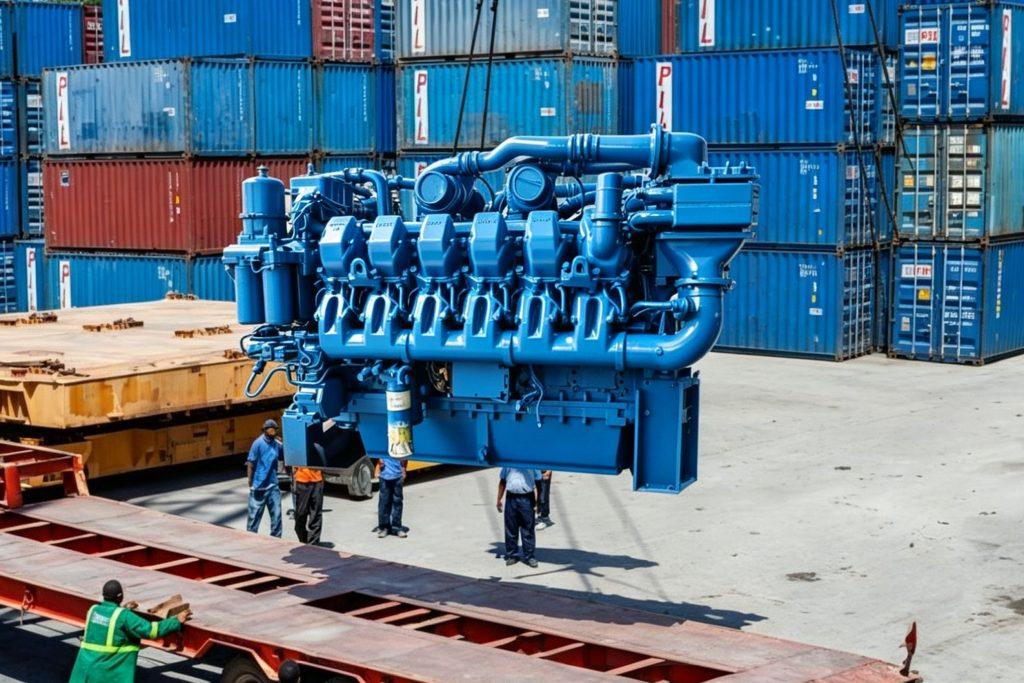
The immediate news signal this week is not a factory promotion. It is a regional energy warning. On June 16, 2026, the International Energy Agency released its Southeast Asia Energy Outlook 2026 and called the recent Middle East supply shock a wake-up call for the region’s energy system. For generator buyers, that matters because fuel risk, grid instability and project delays usually change buying behavior before they show up in public tender language.
For used and refurbished diesel generator buyers, the practical implication is simple: do not wait until your EPC contractor, telecom team or mine-site operator is already chasing emergency backup. Confirm frequency, voltage, destination port, inspection scope and shipment paperwork early. That is especially important when you are sourcing from China on a CIF or FOB basis and need real stock, not brochure inventory.
What changed in the market this week
The IEA said Southeast Asia could account for nearly 20% of global energy demand growth to 2035 under current policies, and warned that the region’s energy import bill could rise to USD 245 billion by 2035 from USD 80 billion in 2024 if diversification moves too slowly. The same week, Associated Press reported that the IEA sees the region’s dependence on imported oil and gas as a direct energy-security weakness. That does not mean every buyer will order a diesel set tomorrow. It does mean backup power decisions are getting pulled forward in markets that cannot tolerate long interruptions.
A separate demand signal came from the critical-power side. On June 2, 2026, Generac announced a global supply agreement with a hyperscale data center operator for backup generators. Even though HXH Power is not selling new hyperscale packages into that segment, the signal is useful: mission-critical buyers are still locking backup power capacity, and generator procurement remains a live resilience category rather than a legacy one.
Why this matters for 50Hz and 60Hz used generator buyers
Many export enquiries still arrive with incomplete technical information. That is where projects slip. Southeast Asia is not one specification block. The Philippines typically works on 60Hz. Indonesia, Vietnam, Thailand and Malaysia are generally 50Hz markets. Buyers who ask only for “a 1000kW used generator” without confirming frequency, voltage, step-load pattern and site altitude usually create avoidable rework later in the deal.
- For telecom backup and commercial standby, buyers usually need fast confirmation on frequency, ATS compatibility and fuel autonomy.
- For mining and remote-site work, buyers usually need stronger attention on radiator condition, load acceptance, alternator match and transport dimensions.
- For dealer stock purchases, buyers should decide whether they need quick-turn warehouse stock, inspection-first stock or units that still need refurbishment.
If you are comparing options now, HXH’s current stock page is the right starting point. If the project is application-led rather than model-led, the solutions page is the better first filter.
Why used and refurbished stock is still competitive in 2026
When regional energy risk rises, buyers do not all move to brand-new equipment. In many cases, they move to faster availability and better documentation. A sound used or refurbished diesel generator can still make commercial sense when the buyer needs one or more of these conditions:
- quicker delivery than a new-build lead time;
- known engine family such as Cummins KTA38, KTA50, QSK60, CAT 3512 or MTU 4000 series;
- budget discipline on secondary power, rental replacement or dealer replenishment;
- inspection proof before final shipment;
- destination-specific export planning with CIF quotation support.
That is where buyer discipline matters more than slogans. Ask for the actual stock list. Ask whether the unit is in warehouse, under rebuild or only sourceable. Ask for recent photos, serial references where appropriate, and the inspection path before shipment. HXH’s projects page shows the type of shipment and loading proof serious buyers should expect.
The export checklist buyers should confirm before booking
- Frequency and voltage: confirm 50Hz or 60Hz first, then voltage and control requirements.
- Prime or standby duty: do not treat site backup, mine load and dealer resale as the same duty cycle.
- Inspection evidence: request current photos, workshop condition, basic testing records and loading confirmation.
- Shipping basis: confirm EXW, FOB or CIF scope, plus destination port and inland constraints.
- Service parts logic: for older Cummins, CAT or MTU units, ask what filters, sensors or common wear parts should travel with the set.
Buyers who wait until the freight booking stage to ask these questions usually lose time on both sides. For repeated dealer purchases, it is more efficient to standardize the enquiry format once and use it for every stock request.
A better way to send the first enquiry
If your team is sourcing for Africa, the Middle East or Southeast Asia, the fastest first message is not “send your best price.” A better first brief is:
- brand or acceptable engine families;
- required power band, such as 500kW, 1000kW or 1500kW+;
- 50Hz or 60Hz;
- destination port;
- whether you need warehouse stock, refurbished stock or dealer replenishment;
- whether the immediate next step is stock list, inspection photos, load-test file or CIF quotation.
That usually gets you to a usable commercial discussion faster. If you already have a live enquiry, use the contact page to request the stock list or EXW or FOB quotation and include the exact model family in the first note.
Sources referenced
- IEA: Southeast Asia Energy Outlook 2026 (released June 16, 2026)
- IEA: 2026 Energy Crisis Policy Response Tracker (updated June 12, 2026)
- Associated Press: Iran war is a wake-up call for Southeast Asia’s energy sector, IEA report says (June 16, 2026)
- Generac press release: global supply agreement for backup power generators (June 2, 2026)