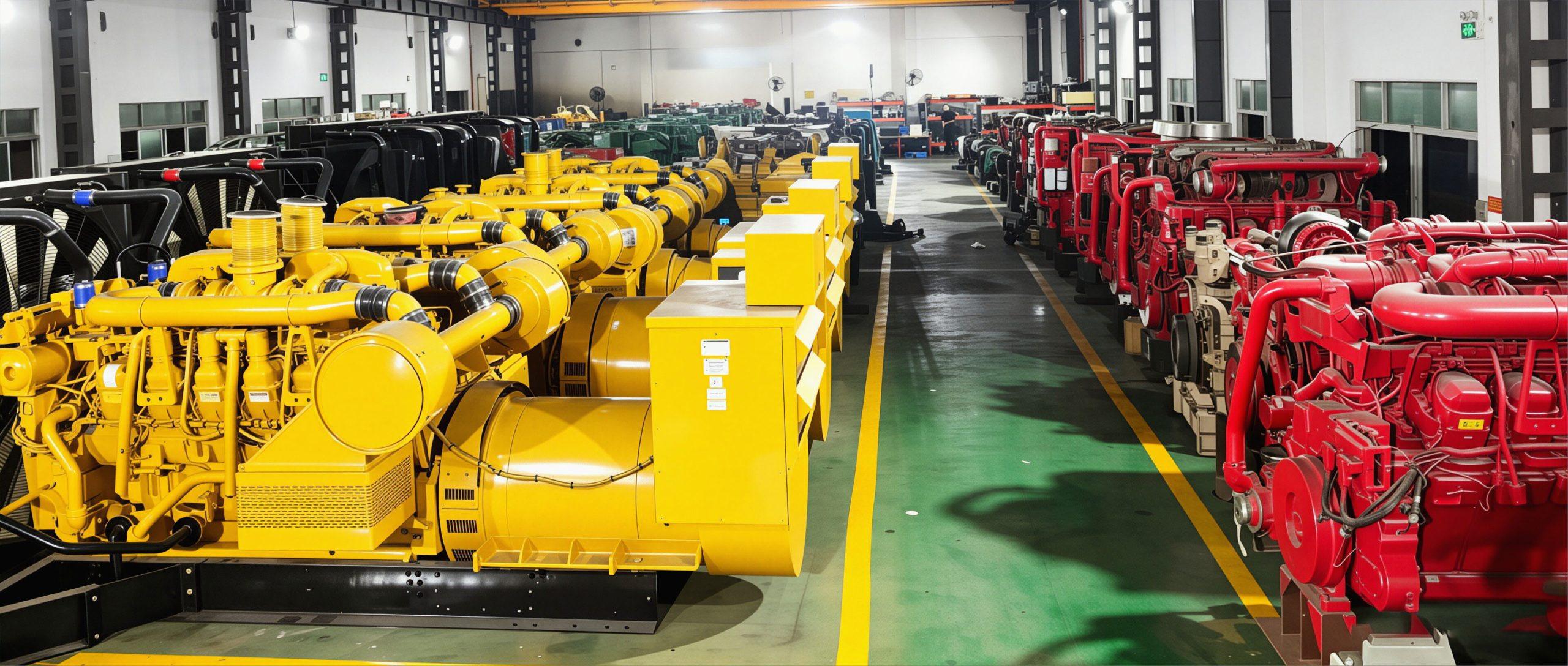
A 60Hz used generator inquiry should not start and end with brand and kilowatt range. The expensive mistakes usually happen earlier: the buyer asks for a familiar model, receives a price, and only later confirms that the frequency, voltage, phase, standby/prime use, or destination-port requirement does not match the project.
For dealers and contractors buying used diesel generators from China, the first job is to make the request specific enough for the supplier to match a real unit, not a catalog description. HXH Power can discuss Cummins, Caterpillar, MTU and other industrial stock, but a 60Hz order needs several checks before price comparison makes sense.
Start with the operating frequency, then confirm the nameplate
Frequency is not a sales label that can be added after the quote. A generator set is built around the alternator, engine speed, controller settings and output configuration. For many four-pole diesel generator sets, 50Hz operation is associated with 1500 rpm and 60Hz operation with 1800 rpm, but the buyer should still confirm the actual nameplate and testing condition of the unit being offered.
This matters for markets that commonly request 60Hz equipment, including the Philippines, parts of the Middle East and many American-market projects. If the site equipment, switchgear or existing fleet is built around 60Hz, a lower-priced 50Hz unit may not be a usable substitute without proper technical review.
What a buyer should send before asking for price
A useful RFQ for a 60Hz used generator should include the destination country, port, required power range, voltage, phase, standby or prime-use requirement, preferred brands, quantity and expected delivery timing. If the buyer is a dealer, monthly or quarterly demand helps the supplier send a stock list instead of a single-unit answer.
For project buyers, the application also matters. A telecom backup unit, a mine-site standby unit and a factory emergency generator are not evaluated in the same way. Load profile, ambient conditions, enclosure requirement, sound requirement and available maintenance support can change what model is practical even when the kW number looks correct.
Ask for stock evidence, not only a model name
With used industrial generators, stock evidence is part of the quotation. Buyers should request current photos, nameplate photos, controller photos, alternator information and clear notes on condition before comparing CIF prices. When available, inspection files, loading photos and export documents reduce the risk of buying from a recycled catalog.
For repeat dealers, this is also why a stock list can be more useful than a PDF catalog. A catalog shows what a supplier may handle; a stock list shows what can actually be discussed now. HXH Power can prepare relevant unit photos and model information after the buyer confirms the country, power range, frequency and preferred brands.
When 50Hz stock can still be discussed
A 60Hz inquiry does not always mean every 50Hz unit is irrelevant. Some buyers ask for 60Hz because their market normally uses it, while the actual project may have its own equipment plan or technical conversion path. That said, the buyer should not assume conversion is simple. The nameplate, alternator, controller, voltage output, cooling condition and load-test basis need to be checked before a supplier treats a 50Hz unit as an option.
If the project engineer has not approved the frequency and voltage match, the safer request is to ask the supplier to separate available 60Hz units from any 50Hz alternatives. That keeps the quotation clean and avoids mixing technically different options in one price table.
How HXH Power can support a faster quote
For export buyers, HXH Power can review the requested frequency, kW range, model preference and destination-port information before preparing a quotation. Current stock can be checked by brand and condition, with supporting photos where available. For dealer inquiries, HXH can also discuss repeated stock-list updates instead of treating every request as a one-off purchase.
Start from the available stock on the products page, review use-case fit on the solutions page, and check proof-style examples on the projects page. Dealers can use the dealer inquiry page to request a stock pack. For a project quotation, send the model, kW range, frequency, voltage, quantity and destination port through the contact page.