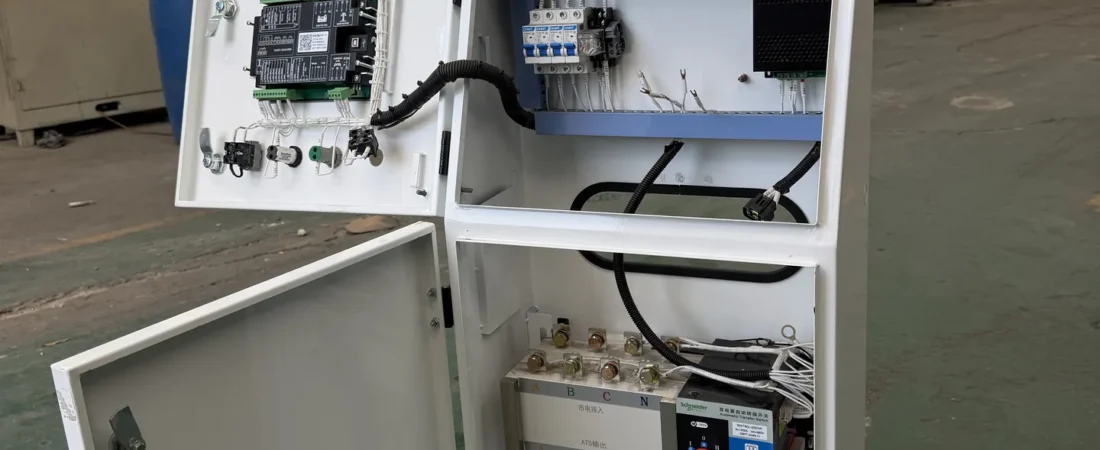
An engine start-up video proves that a used generator can run. It does not prove that the complete generator set can deliver the voltage, frequency, protection and control functions required at the buyer’s site. The alternator and control panel need their own inspection record before shipment.
A practical used generator alternator inspection should connect three sets of evidence: readable identification plates, visible condition, and operating data from the exact unit being quoted. This is especially important for export orders, where correcting an alternator, AVR or controller mismatch after delivery can cost far more than documenting it at the supplier’s yard.
Start with the complete identification record
Ask for clear, current photographs of the engine plate, alternator plate, generator-set plate and controller model. The images should be sharp enough to read, and each file should be traceable to the quoted unit rather than a similar model in the same warehouse.
For the electrical side, record the alternator manufacturer and model, serial number, rated kVA or kW, voltage, frequency, phase, power factor and speed shown on the plate. Also record the AVR and controller model where accessible. A buyer should not infer these details from the engine model alone: one engine family can be coupled to different alternators and control systems.
Compare the plate record with the quotation and the intended site. The site voltage, frequency and phase must be stated in the RFQ. The HXH 50Hz versus 60Hz export checklist explains why frequency should be screened before price or freight is compared.
Check the alternator’s visible condition
The inspection file should show more than the outer casing. Request photographs of the terminal box, accessible cable connections, air inlet and outlet areas, coupling or bearing area where visible, earth connection, and the surrounding base frame. Look for heavy dust, oil contamination, blocked airflow, loose or overheated connections, damaged insulation, corrosion and evidence of water ingress.
Visible condition cannot confirm winding health, but it can identify where a qualified technician should investigate. Dirt and moisture matter because they can reduce insulation resistance. STAMFORD | AvK owner manuals describe winding insulation checks, connection checks and clear air paths as part of pre-running or maintenance work. They also warn that the AVR and connected control wiring may need to be isolated before insulation testing. For that reason, insulation-resistance and winding tests should be completed only by trained personnel using the procedure for the exact alternator model.
If the supplier reports a measured insulation value, ask for the test date, ambient condition, instrument, test setup and exact alternator model. A single number without that context is weak evidence. Do not ask an unqualified person to repeat a high-voltage test for a sales video.
Identify the AVR and excitation arrangement
The automatic voltage regulator is central to output-voltage control, but “AVR included” is not a complete condition statement. Ask for the AVR model, a clear photograph, visible wiring condition and any available service note. If parts have been replaced, the quotation should say whether the installed AVR is original, an approved replacement or an aftermarket alternative.
Excitation arrangements and sensing requirements differ by alternator family. The relevant manufacturer’s manual should govern fault-finding and replacement decisions. A stable no-load reading is useful evidence, but it does not replace verification under the agreed test conditions.
Inspect the controller before relying on its display
Power up the controller and photograph its model and main operating screens. A working display is only the first check. The inspection should confirm that the controller reads the expected generator voltage and frequency, receives engine information where fitted, and shows no unexplained active alarms.
Depending on the installed controller and package, the buyer may also request evidence for:
- manual start and stop;
- local emergency stop;
- battery voltage and charger operation;
- generator voltage and frequency sensing;
- oil-pressure and coolant-temperature indication;
- breaker status or output control;
- remote-start input, if the project needs it;
- alarm history or event log, if the controller supports it.
Controller capability varies. For example, Deep Sea Electronics describes the DSE7320 MKII as providing three-phase generator sensing, protection, event and performance monitoring, and remote communications. That does not mean every used set has those functions enabled or wired. The inspection must follow the actual controller model and configuration on the quoted unit.
Match displayed values with independent test evidence
A controller screen is useful, but the strongest pre-shipment record combines it with independent readings taken by a qualified technician. At minimum, the buyer should agree which values will be recorded, at what load, and with which instrument. The report should identify the exact generator, date and test conditions.
The available evidence may include a cold-start video, warm-up record, no-load voltage and frequency, phase-to-phase readings, staged load readings, current balance, output power and power factor. Not every yard can provide the same load-bank capacity, so the quotation should state what was actually tested rather than imply a full-rated test.
Cummins’ generator-set start-up checklist includes checks for voltage, frequency, phase rotation, control calibration, switchgear operation, stop functions and a recorded load test. That is a useful model for buyer documentation even when a used set is being inspected at a supplier’s facility rather than commissioned at the final site.
Use a clear pre-shipment evidence table
| Evidence to request | What it helps confirm | Preferred file |
|---|---|---|
| Engine, alternator and genset plates | Identity, rating and configuration match | High-resolution photographs |
| AVR and controller model | Parts identity and supportability | Close-up photographs |
| Terminal box and visible wiring | Connection condition and signs of overheating or damage | Photographs before covers are replaced |
| Controller power-up and alarm screens | Display operation, readings and unresolved alarms | Short video plus still images |
| No-load output record | Basic voltage and frequency evidence | Dated test sheet or continuous video |
| Agreed load-test record | Performance under the stated test condition | Test sheet with instrument and load details |
| Repair or replacement list | Scope included in the quoted condition | Written supplier statement |
Define repairs and configuration changes in the quotation
If inspection finds a damaged controller, uncertain AVR, poor terminal connection or low insulation result, the buyer needs a written scope—not a verbal promise that the issue will be handled. State whether the price includes cleaning, drying, reconnection, parts replacement, rewinding, testing or configuration work. Record the replacement brand and part number where relevant.
Changes to voltage, frequency, winding connection, controller logic or protection settings require technical review of the complete package. A 50Hz set should not be advertised as a simple 60Hz conversion, or vice versa, without written confirmation that the engine speed, alternator rating, AVR, controller, cooling system and output rating are suitable for the proposed configuration.
Buyers comparing refurbished units can use the refurbished diesel generator condition checklist for the wider engine, cooling, base-frame and service record. For a full pre-shipment workflow, see the generator inspection before shipment checklist.
What to send with an alternator and control-panel enquiry
Send the project voltage, frequency, phase, required kW or kVA, duty, largest loads, quantity, destination port and preferred controller functions. If you are asking about a listed unit, include the product URL or stock reference so the evidence file is tied to the correct machine.
Buyers can review current HXH generator listings. The used Cummins KTA19-G4 450kW listing is an example of a product record that includes both package information and an alternator nameplate photograph. When the site requirement is ready, send it through the HXH enquiry page for a unit-specific reply.
Frequently asked questions
Is an engine running video enough to approve a used generator?
No. It shows that the engine can start and run during the recording, but it does not by itself confirm alternator identity, output voltage and frequency, controller functions, protection settings or performance at the agreed load.
Should every used alternator receive an insulation-resistance test?
The need, method and acceptance criteria depend on the alternator model, condition and manufacturer’s instructions. When such a test is appropriate, a qualified technician should follow the exact manual and isolate sensitive connected equipment as required.
Can a controller event log prove the generator’s full history?
No. An event log can support the inspection, but it may be limited, cleared, reconfigured or unavailable. Use it together with plate photos, visible-condition evidence, service information and current operating tests.
What should be confirmed before paying a deposit?
Confirm the exact unit identity, quoted configuration, alternator and controller models, voltage and frequency, available test scope, known repairs, included accessories, and the evidence that will be delivered before shipment.
Sources: STAMFORD | AvK owner manuals; Deep Sea Electronics DSE7320 MKII product information; Cummins liquid-cooled generator-set start-up checklist.