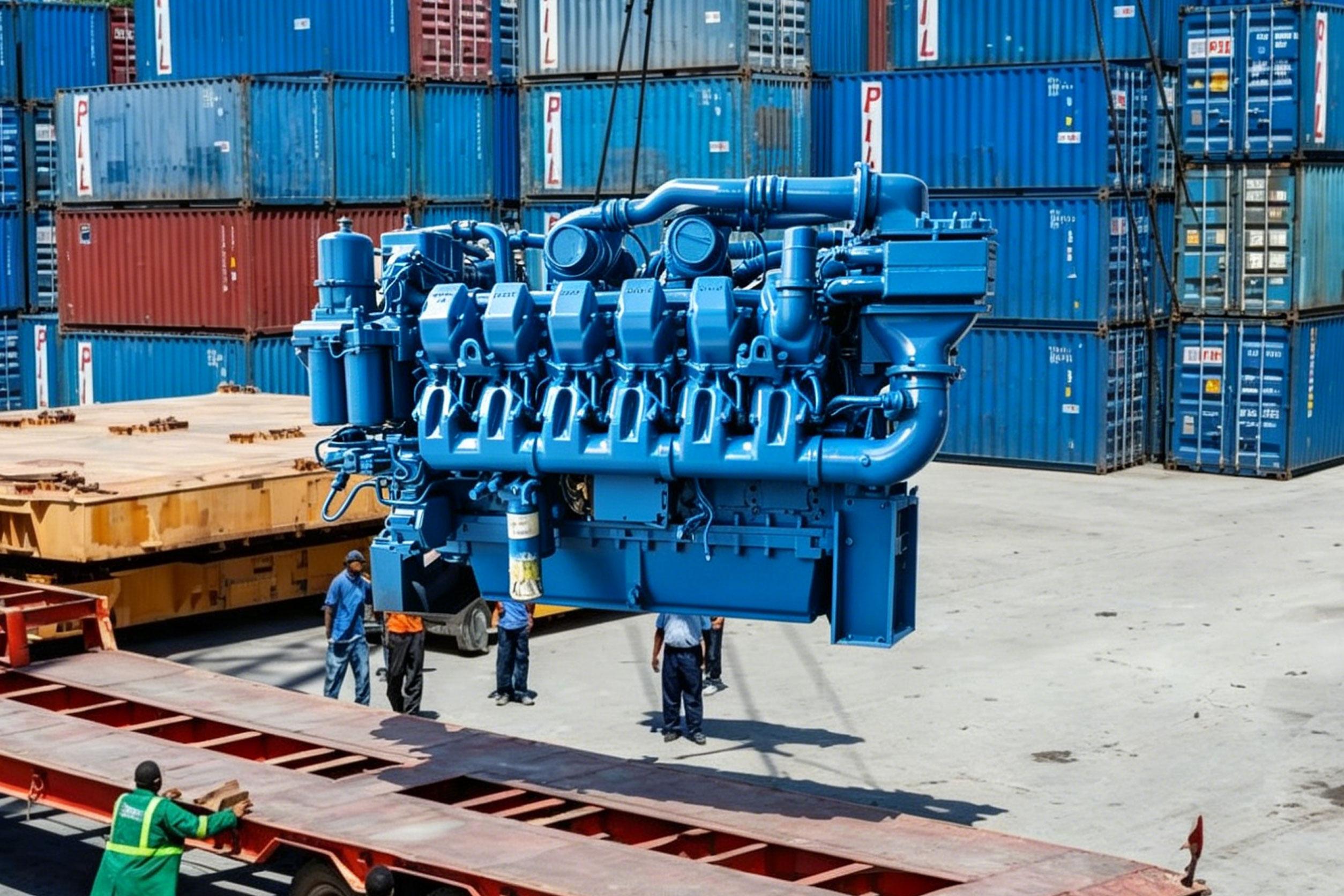
A CIF diesel generator quote can look convenient because the buyer receives one price to a named destination port. That is why many dealers and project buyers ask for CIF first. But for used industrial generator sets, a CIF number is only useful when the unit, loading plan, destination port and proof file are clear.
Incoterms are widely used to define buyer and seller responsibilities in international trade. ICC Incoterms 2020 explains that the rules allocate costs, risks and obligations between the parties. The U.S. International Trade Administration also notes that Incoterms help define who manages shipment, insurance, documentation, customs clearance and related logistics activities. For a used generator buyer, that means the quote should not stop at a model name and a port. It should describe what is being shipped and what the price actually includes.
CIF does not make a weak stock file stronger. It does not confirm that the generator is suitable for the buyer’s load. It does not prove that the unit can fit into a standard container. It also does not replace inspection photos, running video, nameplate images or export loading proof.
Start with a named destination port
A CIF quote needs a named destination port. “Africa,” “Middle East,” “Asia” or even a country name is not enough for serious pricing. Freight cost, sailing schedule, port handling expectation and delivery timing can change between ports in the same region.
A useful inquiry should state the destination port, country, preferred shipping month, quantity and whether the buyer wants only CIF to port or also help understanding inland delivery after arrival. If the buyer asks for “door delivery” or import-duty handling, that is no longer the same simple CIF conversation and needs to be stated separately.
Send the power requirement before asking for freight
Many generator inquiries are too thin. A buyer asks for “CIF price for Cummins generator” but does not include kW or kVA, frequency, voltage, duty, quantity or whether the unit is a complete generator set, engine, alternator, transmission or spare assembly. The supplier then has to guess the equipment class before checking shipping.
For diesel generator sets, the buyer should send required power range, 50 Hz or 60 Hz, voltage, standby or prime duty, brand preference, model preference if any, quantity, destination port and expected order timing. For resale buyers, it helps to state the market: dealer stock, tender support, emergency backup, mine site, telecom site, factory standby or commercial building backup.
If frequency or voltage is still not confirmed, review the 50Hz vs 60Hz export checklist before asking for a final CIF comparison.
The cargo plan affects the price
A generator set is not always a simple container shipment. Some units can ship in a standard container after proper packing. Larger units may require open-top, flat-rack, platform or other special-cargo handling. Maersk describes oversized and overweight cargo as cargo that exceeds the proportions and capability of a single standard container, and its container guide lists open-top and flat-rack options for cargo that is over-height or oversized.
That is why a CIF quote should be tied to an actual unit, not only a model family. The supplier needs to check dimensions, weight, lifting points, base frame, radiator arrangement, loose parts, packaging method and whether any component must be separated for shipment. If a buyer compares two CIF prices without checking the cargo plan, the cheaper number may be based on a different packing assumption.
For buyers who care about shipment evidence, HXH keeps the export proof angle separate in this guide: why export loading proof matters when buying used diesel generators.
Insurance is not the same as condition proof
Under CIF, insurance is part of the trade-term discussion. ICC’s Incoterms 2020 material notes that CIF and CIP have different insurance coverage levels, with CIF keeping Institute Cargo Clauses (C) as the default level unless parties agree to more cover. That matters, but insurance should not be treated as a substitute for checking the generator.
Before a buyer accepts a CIF quote, the stock file should show the actual unit: wide photos, nameplates, control panel, alternator, radiator, base frame, visible condition, running or test video where available, and packing or loading proof before shipment. Insurance can help address defined transit risk. It does not answer whether the quoted machine was correctly selected, inspected or packed.
Compare CIF prices only after the files match
A buyer can compare CIF prices fairly only when the compared offers cover the same equipment scope. One offer may include a complete generator set with controller, radiator and base frame. Another may quote only an engine or an incomplete package. One may include stronger inspection material. Another may show only old photos or a catalog image.
Before comparing prices, ask for these items in the same format:
- brand, model and power range of the quoted unit;
- 50 Hz or 60 Hz, voltage and standby or prime use;
- included components, such as alternator, controller, radiator, base frame and loose accessories;
- current photos, nameplates and running or test evidence where available;
- estimated dimensions, weight and packing method;
- destination port and whether CIF covers only the named port;
- expected shipment timing and validity period of the quote.
This checklist is also useful for dealers requesting multiple models at once. If the inquiry is a dealer stock request rather than a fixed project, send the resale market, monthly or quarterly demand, preferred brands and acceptable power range. HXH can then screen stock instead of sending a broad file that does not help the buyer quote their customer.
For a wider stock-list request format, see what dealers should send when requesting a used generator stock list.
What HXH needs for a faster CIF quote
To request a practical CIF diesel generator quote, send the model or power range, frequency, voltage, duty, quantity, destination port and whether the buyer needs a full generator set or a component. If there is a preferred brand such as Cummins, Caterpillar, MTU, MWM or Jenbacher, include it. If the buyer has a deadline, state the target shipment window.
HXH can then check available stock, confirm whether the unit fits the buyer’s use, prepare relevant photos and proof files, and quote with a clearer shipping basis. The stronger the inquiry, the less time is wasted comparing numbers that were never based on the same machine.
Contact HXH Power to request current used diesel generator stock, inspection photos and CIF quote support.